Evanston Debates Healthy Buildings Ordinance & The New Administration's Energy Freeze | Policy Update: January 2025
In this month’s edition of the Illinois Green Policy Update, we're covering the ups and downs on a number of developing local and national sustainability stories and outlining ways you can take action right now, including: the status of Evanston’s proposed Healthy Buildings Ordinance; the
Trump administration’s moves on climate policy;
Chicago’s 2025 budget; and
more!
Evanston Debates Healthy Buildings Ordinance
On Monday, January 27, Evanston City Council debated the Healthy Buildings Ordinance, a proposal that would set efficiency performance targets for buildings over 20,000 square feet.
“This is a pivotal part of our climate action and resilience plan. It allows us to have the 500 largest buildings in Evanston comply with that goal of no carbon by 2050,” said Evanston Mayor Daniel Biss. “The research that we have done shows that 53% of our emissions come from our large buildings.”
Dozens of members of the public showed up to share their thoughts, with the majority being supportive of the initiative. Our Policy Associate Ryan Wilmington joined to share the perspectives of the green building community.
“We know [the Healthy Buildings Ordinance] is viable because our members—the experts in the industry—are already adopting the technologies and building practices that this ordinance encourages,” Wilmington said. “Clean buildings are simply more healthy, more affordable, and more resilient. There’s a reason why leaders in the industry are already doing this.”
Evanston-based architect and owner of Kipnis Architecture + Planning, Nate Kipnis, added “Reaching [the goals of the Healthy Buildings Ordinance] should not be difficult. These buildings will need to do periodic equipment updates and those are opportunities to improve the buildings systems.”
Affordable housing developer T. Manning spoke about the benefits of retrofitting buildings, saying, “While there has been a modest cost associated [with retrofits] it is possible to dramatically reduce utility costs for tenets. The buildings that my company rehabbed are between 25 and 45 percent more energy efficient than before... now that they’re more energy efficient [they] have saved the tenants approximately $40,000 to 45,000.”
After a long conversation running until 10:30 PM, Evanston City Council decided to delay the vote by two weeks to give community stakeholders more time to provide their thoughts. Those who live, work, or have a connection to Evanston or Northwestern University can learn how to get involved here!
The New Administration's Energy Freeze
President Trump’s return to office has been accompanied by executive orders pulling out of the Paris Climate Agreement, reaffirming his commitment to fossil fuels, expressing his love for gas appliances, and attempts to halt all federal assistance programs.
While all of these actions are harmful to sustainability goals, most worrying was the attempt to halt federal assistance designed to increase investment in clean energy, energy efficiency, and support the adoption of new energy codes.
The funding halt was immediately challenged in court and many nonprofits and states, including Illinois, are planning lawsuits. As of 5 PM on January 28, it appears that this effort will be blocked by a federal judge, at least until February 3.
While green programs like the Inflation Reduction Act (IRA) are safe for now, it is clear that they are on the chopping block for this administration. Illinois Green strongly supports the IRA and its goal to spur investment in building decarbonization projects and the adoption of new clean energy technologies. This legislation has already brought hundreds of millions in funding to our state for decarbonization efforts, workforce development, solar programs, and code adoption and more programs are under way. The IRA needs to stay, without any cuts or tampering.
Now, we want to show that the industry is fully behind the Inflation Reduction Act. The voice of building sector businesses and professionals will be crucial to protecting the IRA and it’s decarbonization initiatives. Use this 1-click tool to tell your Representatives to support the IRA.
Policy Spotlight
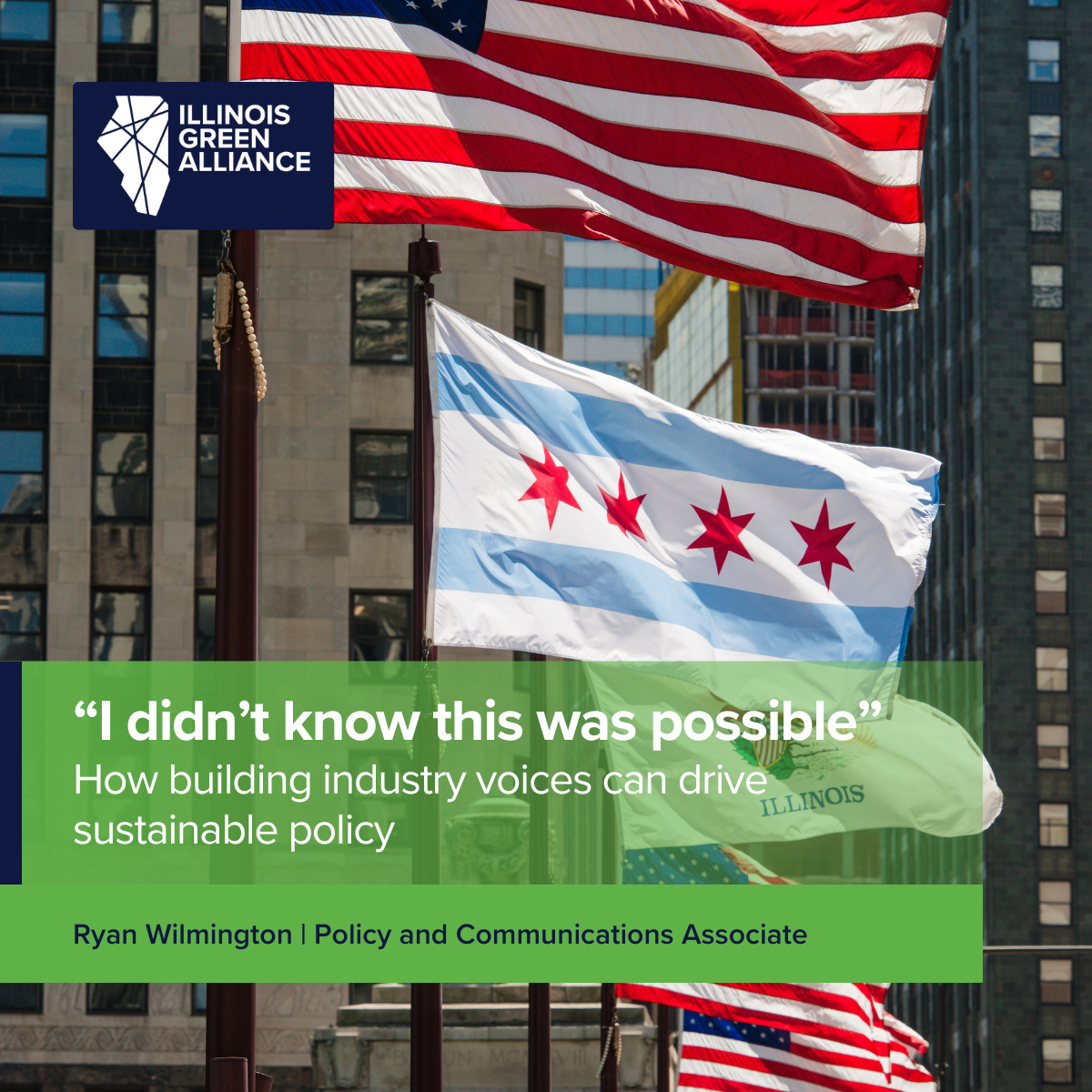
There has been enormous success in the green policy space over the last few years, with multiple landmark bills coming from all levels of government. These pieces of legislation have the potential to change the building industry and elevate the role that sustainable buildings will play in reducing carbon emissions. But, as the news this month shows, we'll face new challenges to ensuring the green movement continues forward.
In this letter, our Policy Associate Ryan Wilmington shared his thoughts on the state of clean building policy and took a look at how building professionals can make a difference in 2025.
Chicago's New Budget & Green Buildings
At the end of 2024, Mayor Brandon Johnson and the Chicago City Council came to an agreement on Chicago’s Fiscal Year 2025 budget, which outlined how each department in Illinois’ largest city will be furthering building decarbonization goals. Here are some highlights.
- The recently reinstated Department of Environment received a modest boost to $2.4 million in annual funding from $1.8 million previously.
- This funding will help the new department start to take on more responsibilities and develop plans to transition environmental functions from other departments.
- One of these new responsibilities will be managing the city’s energy benchmarking program.
- The Department of Housing will be continuing one building decarbonization program while rolling out a major new initiative.
- The former is the Green Homes Chicago pilot program, which provided no-cost home electrification and weatherization to low-income households and will be returning later in the year.
- The Green Social Housing Revolving Fund, a major component of Mayor Johnson’s $1.25 Billion bond initiative from last year, will provide low-cost seed loans for affordable housing, a new funding method that has been piloted in other cities. However, the ‘green’ aspects of the program are still unclear.
- The Department of Planning and development will be investing $25 million into their Missing Middle Housing Initiative, a program that will make city-owned lots across the south and west sides available for one to six-unit market rate developments.
- The Department of Buildings won’t be seeing any major funding changes and will be rolling out an updated permitting system this year.
For more on these initiatives and Chicago’s other environmental plans, check out Illinois Environmental Council’s Budget Analysis.
Get news and advocacy alerts in your email! Sign up for our new policy newsletter!
The new Illinois Green Policy Newsletter will bring this monthly update, feature stories and timely advocacy action alerts directly to your inbox. Sign up to stay up to date on the latest local sustainability policy news and the ways you as a building professional can use your expertise make a difference.
Green Policy Highlights
The deadliest building in Chicago for birds dramatically slashed bird deaths with a small fix—polka dot stickers. Aiming to reduce the number of bird collisions, the owners and operators of McCormick Place installed window film with thousands of polka dots and the results have been shockingly effective. Bird collisions dropped 95% since the film was installed!
Still, Chicago remains the most dangerous city in the U.S. for birds as the migratory path for more than 250 species puts them at conflict with the city’s many large, brightly lit glass buildings. Policymakers have also been working to reduce these risks by through programs like Chicago’s Sustainable Development Policy, Lights Out Chicago, and Illinois’s Bird Safe Buildings Act.
Read more here - WBEZ
In Other Sustainability News